
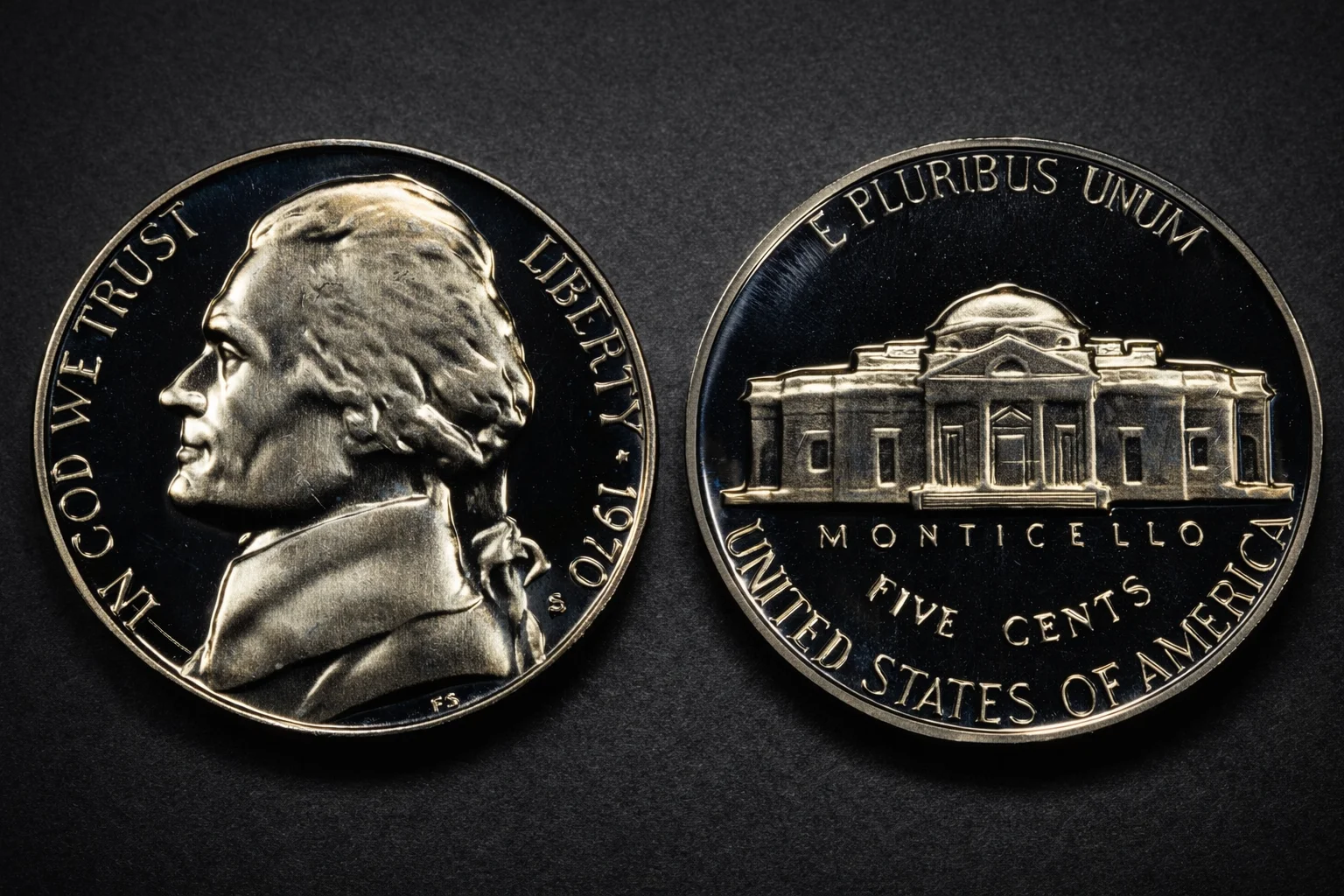
The 1970 S nickel was never released for circulation. Every piece was struck as a proof coin in San Francisco. There are no business strikes for this date. That single fact defines its entire market behavior.
At first glance, it looks ordinary:
Standard copper-nickel alloy
No silver
No key-date status
Yet collectors treat proof-only years differently. So, let’s explore and check what makes the date and these coins special.
What “Proof-Only” Really Means
In 1970, Jefferson nickels were not struck for circulation at Philadelphia or Denver. The only nickels produced for that year came from San Francisco, and all were proof strikes.
Proof coins are made differently from circulation coins:
Polished dies
Carefully prepared planchets
Multiple strikes under higher pressure
Manual inspection
They were sold only inside official proof sets. They were not intended to enter commerce.
Proof-only does not mean rare. It means the coin exists in one strike format only. That format is higher quality but also more fragile.
Technical Details
Parameter | Specification |
Year | 1970 |
Mint | San Francisco (S) |
Strike Type | Proof |
Composition | 75% copper, 25% nickel |
Weight | 5.00 grams |
Diameter | 21.2 mm |
Edge | Plain |
Designer | Felix Schlag |
Reverse | Monticello |
The alloy is standard for modern Jefferson nickels. There were no silver issues for 1970. The difference lies in production quality, not metal content.
Mintage and Availability
Approximately 2.63 million proof sets were produced in 1970. Each set included one Jefferson nickel.
This is a moderate number. It is not low. Most coins were preserved in packaging.
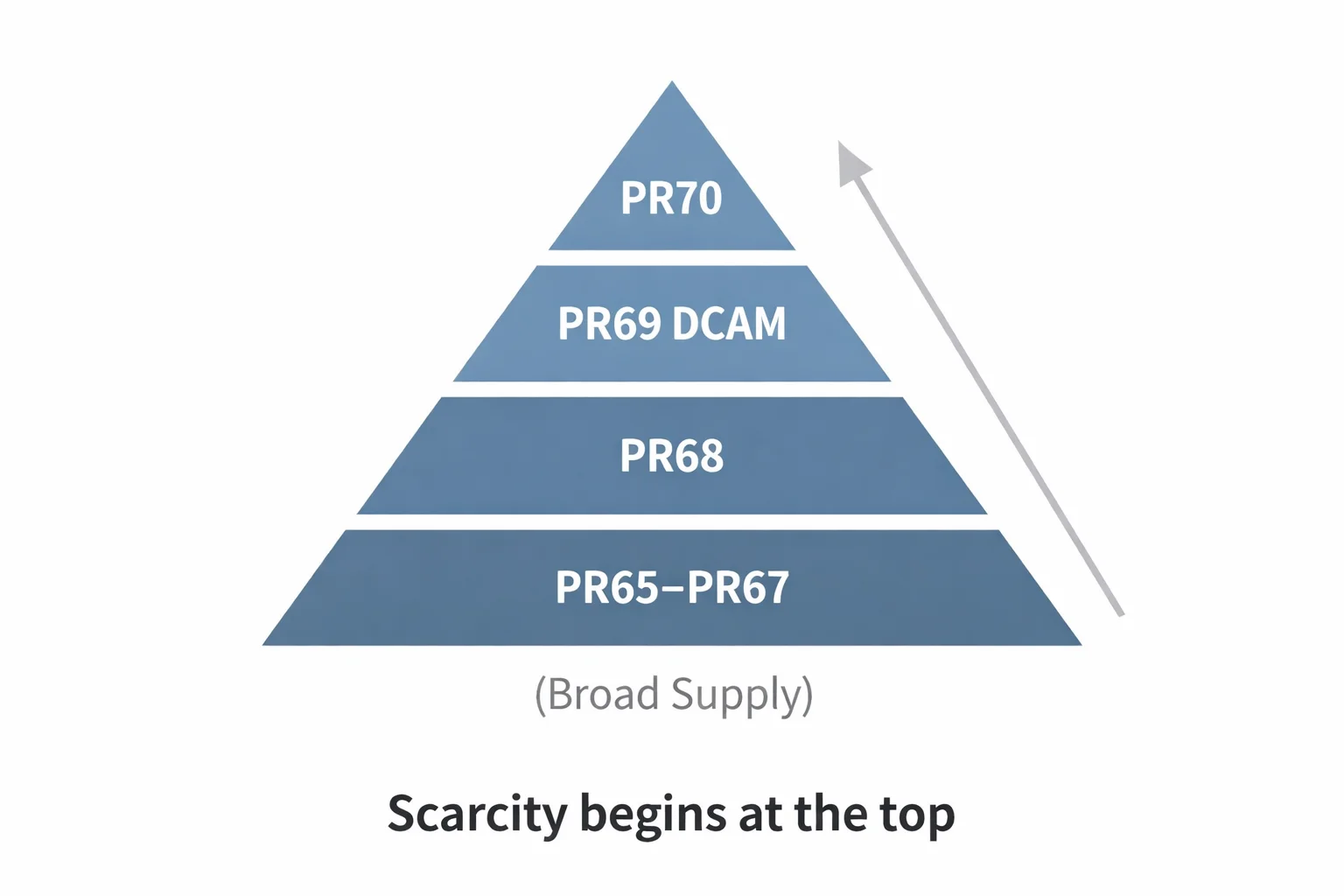
Because of that, examples in PR65 to PR67 remain easy to obtain. The market is well supplied at those levels.
High mintage combined with careful storage explains why the coin is widely available today.
Scarcity begins only at the highest quality levels.
Understanding the Proof Finish
Proof coins are defined by contrast and surface depth:
Mirror Fields
The flat areas are polished to a reflective finish. They act like a mirror under light. Any hairline scratch becomes visible.
Frosted Devices
The raised design elements can show a matte texture. This frost creates contrast against the mirror background.
Proof coins are struck more than once. This ensures sharper detail. However, surface perfection is difficult to maintain over time.
Small contact, improper cleaning, or packaging haze can reduce quality quickly.
Cameo and Deep Cameo
The most important factor in a 1970 proof nickel is contrast. There are three general categories:
No Cameo → Minimal contrast between devices and fields.
Cameo (CAM) → Moderate contrast. Devices appear lightly frosted.
Deep Cameo (DCAM) → Strong contrast. Devices are heavily frosted and clearly stand apart from deep mirrored fields.
Deep Cameo coins usually come from early die states. As dies are used, the frost fades. Later strikes show weaker contrast.
This creates a natural hierarchy:
PR67 without cameo < PR67 CAM < PR67 DCAM
In higher grades, DCAM status can double or triple the value compared to non-cameo examples.
Contrast matters more than the date.
Grade Structure and Market Levels
Most 1970-S nickels fall into the mid-proof range.
PR65: common
PR66: common
PR67: very available
PR68: selective
PR69: scarce
PR70: extremely rare
The jump from PR68 to PR69 can be significant. The jump to PR70 is dramatic because almost no coins survive in flawless condition.
The difference between PR68 and PR69 often comes down to: micro hairlines; minor haze; tiny contact marks.
Proof coins show flaws easily. Perfect surfaces are uncommon. For example, the 1970 proof nickel has several typical issues:
Issue | What It Looks Like | Market Impact |
Haze | Cloudy or milky film over mirror fields | Reduces reflectivity, lowers eye appeal, can drop grade |
Hairlines | Fine parallel lines visible under light | Evidence of mishandling, limits grade potential |
Over-Dipping | Dull or washed-out frost, unnatural brightness | Weakens cameo contrast, reduces collector interest |
Planchet Flaws | Small metal voids or rough spots | Caps maximum grade, often permanent |
Surface condition defines value more than any other factor.
Price Structure by Quality Level
Prices vary by certification service, cameo designation, and overall eye appeal. The ranges below reflect typical U.S. market levels for certified examples.
Grade | Typical Market Range (USD) |
PR65 | $3 – $6 |
PR66 | $4 – $8 |
PR67 | $6 – $12 |
PR68 | $15 – $35 |
PR69 | $40 – $90 |
PR69 CAM | $60 – $120 |
PR69 DCAM | $120 – $250 |
PR70 DCAM | $1,000+ (auction dependent) |
* Prices reflect recent market activity and may change over time depending on demand, silver markets, and population reports.
Market Interpretation
PR65–PR67 examples remain inexpensive and widely available.
PR68 coins show a clear premium due to improved surface quality.
PR69 DCAM examples carry strong prices because supply narrows at this level.
PR70 pieces are rare and typically sell through competitive auctions.
Most value concentration occurs at PR69 DCAM and above.
At lower grades, the coin behaves like a typical modern proof issue with stable, modest pricing.
Who Should Collect It?
Different buyers approach this coin differently:
Beginnes: A clean PR66 or PR67 examples are always appealing and have a lower prices.
Proof Specialist: Focus on PR69 DCAM coins with strong frost and no haze.
Registry Competitor: Target highest certified grade available, ideally Deep Cameo.
Investor: Only high-grade DCAM examples show meaningful long-term upside.
The majority of examples will remain affordable. Only elite pieces break from that pattern.
Comparison with 1968-S and 1969-S
Late 1960s proof nickels share similar characteristics.
Mintage numbers are comparable. Strike quality is similar. Cameo availability follows the same pattern.
The 1970-S does not stand out as scarcer than surrounding years. Its value structure matches the broader late-1960s proof series.
Collectors treat it as part of a larger proof run, not as an isolated rarity.
Long-Term Outlook
The 1970-S nickel benefits from three factors:
Proof-only status
Moderate mintage
Strong cameo premium structure
However, supply remains stable. Many coins survive in good condition.
Price growth depends almost entirely on grade scarcity. PR65 coins will not suddenly become rare. PR69 DCAM coins already sit in limited territory.
This is a condition-sensitive issue, not a rarity-driven one.
Practical Evaluation Checklist
When examining a 1970-S nickel:
Confirm the “S” mint mark.
Inspect fields for haze under angled light.
Check for hairlines using magnification.
Evaluate contrast between devices and fields.
Look for consistent frost on both sides.
Strong cameo must appear on obverse and reverse. Surface quality is everything.
Conclusion
The 1970-S Jefferson nickel represents a proof-only year with stable supply and predictable structure. It is not rare by production. It becomes interesting only when quality rises.
Most examples remain affordable. A small number achieve higher value because of preservation and contrast.
But if you are a beginner, you can use special tool for easy reference. Try the Coin ID Scanner app. It confirm mint mark, strike type, and technical details carefully. The app offers a great coin database (more than 187,000 world coins) and a built-in assistant that helps verify specifications before deeper grading decisions.
The 1970-S nickel proves a simple rule: in modern proof coinage, condition and contrast define value more than date alone.